About the Journal
"Bulletin of Taras Shevchenko National University of Kyiv. Chemistry" is a peer-reviewed open access periodical scientific journal.
ISSN: 1728-2209
DOI: https://doi.org/10.17721/1728-2209
Cluster: Chemistry, chemical technology, and pharmacy (Specialty E3 Chemistry).
Print media identifier in the register of media entities: R30-03802 (Decision of the National Сouncil of Television and Radio Broadcasting of Ukraine № 1089 dated 28.03.2024).
The magazine is included in the list of scientific subject area journals of Ukraine (category B) in the subject area 102 Chemistry (order of the Ministry of Education and Culture No. 409 of March 17, 2020).
Founder:
Taras Shevchenko National University of Kyiv
USREOU: 02070944
Legal address: 60, Volodymyrska Str., Kyiv, Ukraine, 01033.
Postal address: 64/13, Volodymyrska Str., Kyiv, Ukraine, 01601.
Publisher:
Kyiv University Publishing and Printing Center
(14, Taras Shevchenka Blv., off. 43, Kyiv, Ukraine, 01030).
Deputy Head: Nataliya MELNYCHUK
(+38(044) 239-3222; vpc_div.chief@univ.net.ua)
Head: Ganna Kharlamova
Editorial Address: Hetman Pavlo Skoropadsky St, 12, 01033, Kyiv, Ukraine; chemistry.bulletin@knu.ua
Year of foundation: 1958 (in 2009, 2011-2012, 2021-2022 the publication of the journal was suspended).
Languages of Publication: Ukrainian, English.
Periodicity: once a year
Current: 60 № 1 (2025)
Current Issue
Vol. 60 No. 1 (2025): Bulletin of Taras Shevchenko National University of Kyiv. Chemistry
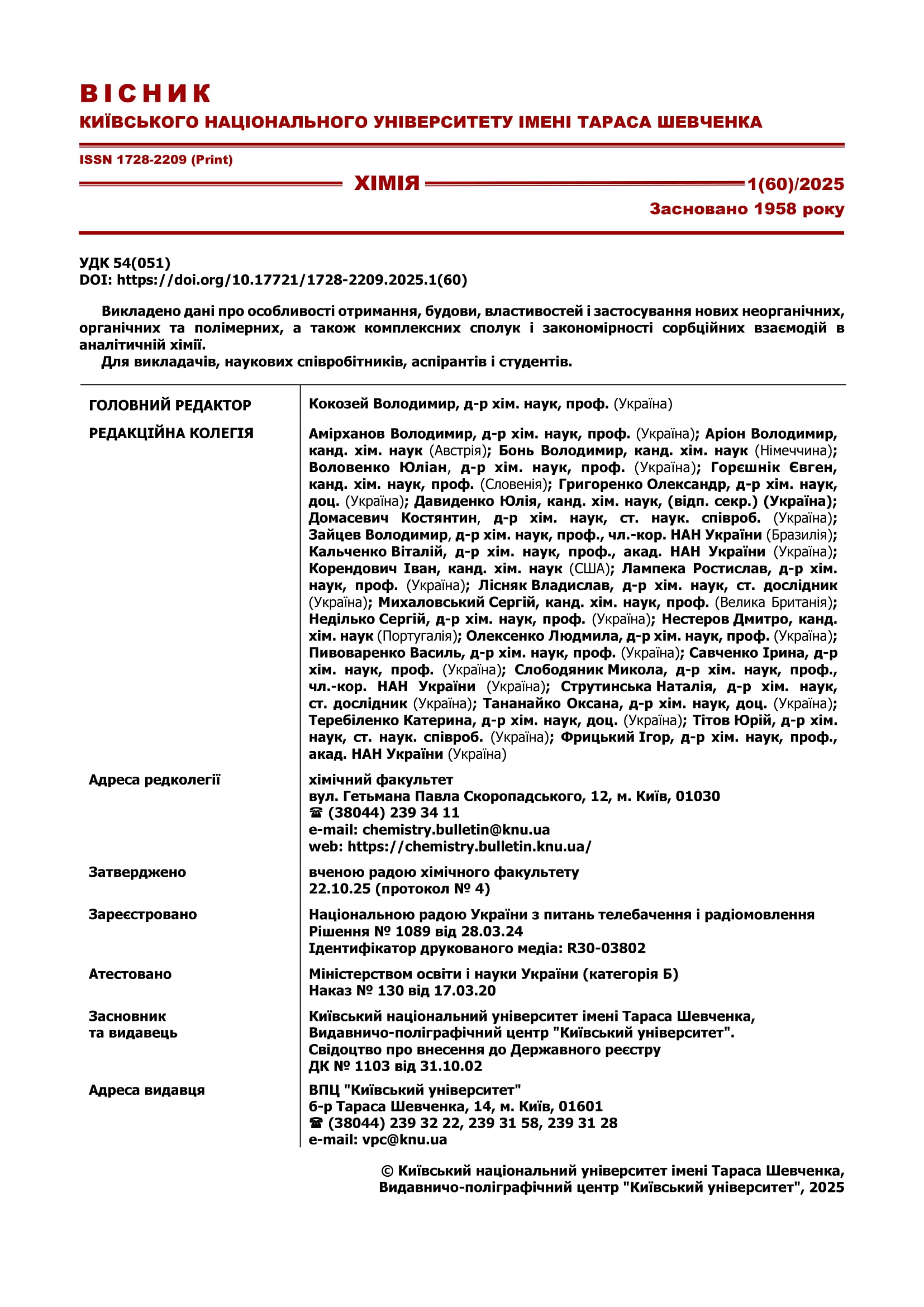
UDC 54(051)
DOI: https://doi.org/10.17721/1728-2209.2025.1(60)
This issue is dedicated to current research in the field of synthesis, modification, and application of new functional materials, development of modern methods of chemical analysis, and creation of biologically active substances. The papers discuss the synthesis and thermal stability of new heterocyclic and modified polymer compounds, as well as the characterization of nanostructured phosphate glasses and complex oxide systems. The regularities of complexation of lanthanides and transition metals, features of the structure of metallic melts, as well as new approaches in spectrophotometric and electrocatalytic analysis are highlighted.
For university lecturers, researchers, postgraduate students, and higher education applicants.
Published:
2025-12-28
Full Issue